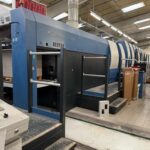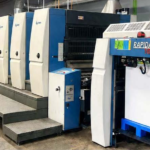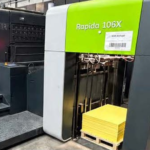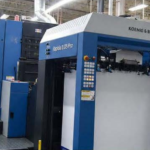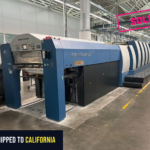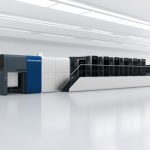
UV and conventional offset presses share the same fundamental lithographic process: inked and non-image areas are separated on the plate, the image transfers to a blanket, and the blanket prints the sheet. The key difference is what happens after the ink reaches the substrate.
Conventional offset ink dries mainly through absorption into the stock and oxidative polymerization. UV ink contains photoinitiators and reactive components that cure rapidly when exposed to the correct ultraviolet energy. That distinction changes the press configuration, consumables, substrates, finishing timeline, maintenance practices, and economics of the job.
Conventional Offset: Proven, Flexible, and Economical
Conventional sheetfed offset is the default choice for a large share of commercial printing: brochures, books, direct mail, forms, catalogs, inserts, and general marketing materials. Inks and compatible consumables are widely available, operator familiarity is high, and a good used conventional press can offer substantial productive capacity at an attractive capital cost.
The tradeoff is drying time. Coated sheets may require spray powder, careful pile management, and time before perfecting, cutting, folding, coating, or other postpress work. Heavy ink coverage can increase the risk of setoff, marking, blocking, and delayed finishing. Conventional ink also has limited adhesion on nonabsorbent materials unless the substrate is specially treated or a suitable specialty ink system is used.
UV Offset: Immediate Cure and Expanded Capability
A properly configured UV press cures ink at or near the delivery, so sheets can move quickly to finishing. Because UV ink cures rather than relying on absorption, it can produce strong color and sharp detail on coated papers, plastics, films, foils, synthetic stocks, metallized materials, and other nonporous substrates—subject to appropriate surface treatment, ink selection, and testing.
UV is particularly valuable for packaging, labels, point-of-purchase work, plastic cards, high-end commercial pieces, and jobs requiring immediate turnaround. Interdeck curing can pin or cure a color before the next unit, enabling opaque white, special effects, multiple coatings, and difficult ink sequences. A delivery-only UV system offers less application flexibility but may still provide immediate final cure.
UV is a system, not just a dryer
A genuine UV-capable press may require UV-compatible rollers and blankets, wash chemistry, ink agitators or temperature controls, shielding, exhaust, safety interlocks, suitable coatings, and electrical and cooling infrastructure. A dryer added to an otherwise conventional press does not automatically create a production-ready UV platform.
Traditional UV, Low-Energy UV, and LED-UV
Traditional UV commonly uses mercury-vapor lamps and can deliver the broad wavelength output and curing intensity needed for demanding applications. It is proven and versatile, but the lamps generate heat, require warm-up and cooling, consume significant power, and may require ozone extraction and ventilation.
Low-energy UV systems use fewer or differently doped lamps and matched inks to reduce energy and heat compared with full traditional UV. LED-UV uses light-emitting diodes at a narrow wavelength. LED units switch on and off instantly, produce little infrared heat, generate no ozone at the lamp, and can offer long service life. However, LED requires wavelength-matched inks and coatings, and the initial equipment and consumable costs can be higher.
Side-by-Side Comparison
| Factor | Conventional offset | UV offset |
|---|---|---|
| Drying / curing | Absorption and oxidation; finishing may need to wait. | Rapid cure under the correct UV dose; sheets can often move directly to finishing. |
| Substrates | Best suited to paper and board that accept conventional ink. | Broad capability on coated, nonporous, synthetic, film, foil, and specialty stocks when properly specified. |
| Appearance | Excellent quality; uncoated stocks retain a natural look. | High holdout, strong color, gloss potential, and special-effect capability. |
| Setoff and powder | May require powder and careful pile control. | Cured ink minimizes setoff and can reduce or eliminate powder for suitable jobs. |
| Consumable cost | Generally lower and widely available. | UV inks, coatings, washes, rollers, blankets, and lamps can cost more. |
| Energy / infrastructure | Standard press utilities; IR/hot air may be used for coatings or drying assistance. | Traditional UV can have high electrical, cooling, and exhaust demands; LED-UV lowers heat and eliminates lamp warm-up. |
| Maintenance | Familiar pressroom routines and broad service support. | Adds lamp or LED modules, reflectors, cooling, shielding, interlocks, and UV-specific maintenance. |
| Operator safety | Normal offset chemical and machinery controls apply. | Requires strict control of UV exposure, heat, ozone where applicable, uncured ink, and compatible wash-up procedures. |
| Best fit | Mainstream paper-based commercial work with cost-sensitive production. | Fast-turn, specialty substrate, packaging, label, plastic, coating, and value-added applications. |
The Economic Decision
UV earns its premium in three ways: it shortens the time between press and finishing, expands the range of work the press can accept, and reduces drying-related defects. Those gains can be substantial in a plant where jobs are waiting on dry time, customers pay for specialty effects, or nonporous substrates are a core market.
The premium is harder to justify when nearly all work is printed on ordinary paper, schedules already allow adequate dry time, and customers will not pay for the additional capability. In that environment, higher ink and maintenance costs may outweigh the production benefit. Conventional equipment may also offer a much broader and less expensive selection in the used market.
A printer considering hybrid capability should study the changeover procedure. Some presses can alternate between conventional and UV applications, but rollers, blankets, washes, inks, and operating practices must be compatible. Poorly managed changeovers can cause swelling, contamination, curing problems, and excessive downtime. “Hybrid” should be verified as an engineered and documented capability, not assumed from a seller’s description.
What to Inspect When Buying a Used UV Press
Begin with the exact curing configuration: number and location of lamps, interdeck versus end-of-press placement, lamp type and wavelength, maximum power, supported sheet width, and whether the system is OEM-integrated or retrofitted. Confirm that every lamp module, shutter, reflector, cooling circuit, exhaust component, and safety interlock operates under load.
Review lamp hours, irradiance or dose records, cooling and electrical service history, and replacement-part availability. Inspect UV rollers and blankets for glazing, swelling, cracking, or chemical damage. Ask for the ink, coating, wash, and maintenance products used by the seller and compare them with the manufacturer’s compatibility requirements.
A production test should include the substrate and coverage that matter to the buyer—not only an easy coated-paper demonstration. Test adhesion, cure, rub resistance, blocking, odor or migration requirements where relevant, finishing behavior, and both sides of the sheet. If the work includes food, pharmaceutical, or other sensitive packaging, obtain specialized ink and regulatory guidance; standard UV capability alone does not establish suitability.
Which One Should You Buy?
Choose conventional when your core work is paper-based, price competition is intense, drying time does not constrain throughput, and you want the simplest, lowest-cost route to dependable offset capacity.
Choose UV when immediate finishing, nonporous substrates, heavy coverage, coatings, opaque white, specialty effects, or premium packaging are central to the business case. Consider LED-UV when lower heat, instant switching, reduced ozone and long emitter life align with the job mix—but price the matched consumables and confirm the curing window for every intended application.
The best press is not the one with the longest option list. It is the one whose configuration matches the products your customers buy, produces them at an acceptable total cost, and can be supported for years after installation.
Sources and Further Reading
HEIDELBERG — Prinect Inpress Control 4: https://www.heidelberg.com/global/en/print_and_packaging/products/offset_printing/press_control_systems/color_and_quality_measurement/inpress_control_2/product_information_122/prinect_inpress_control.jsp
HEIDELBERG — Prinect Axis Control: https://www.heidelberg.com/global/en/print_and_packaging/products/offset_printing/press_control_systems/color_and_quality_measurement/axis_control/product_information_123/prinect_axis_control.jsp
Komori — Integrated Print Quality Control Systems:
https://www.komori.com/en/global/product/press/
HEIDELBERG — LE UV and LED UV Printing: https://www.heidelberg.com/global/en/print_and_packaging/consumables/print_application_support_1/led_le_uv_application_support_1/overview_le_led_uv_application_support_1/overview_application_le_uv_led_uv.jsp